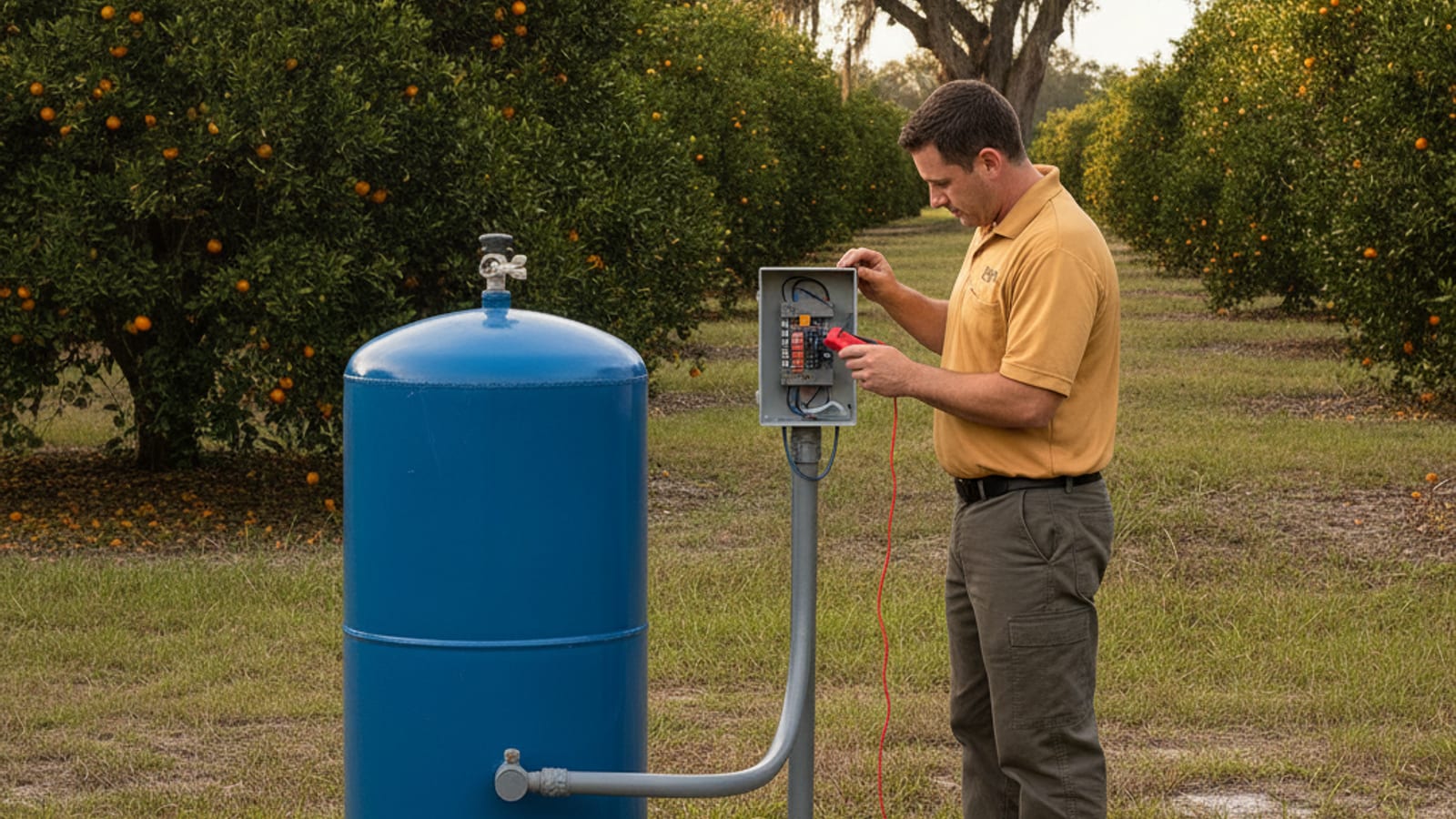
If you’re on well water anywhere in the rural stretch of Polk County, Fort Meade, Homeland, Alturas, Waverly, or the acreage outside Frostproof, a well pump that suddenly stops delivering water is one of the more stressful problems a homeowner can face. It’s also one of the most commonly misdiagnosed, because the actual fault is electrical more often than people assume, not the pump itself.
Start with the pressure tank, then move to the panel
Before assuming pump failure, check the pressure switch and pressure tank. A well system that’s losing pressure gradually rather than cutting out completely often points to a waterlogged tank or a failing pressure switch, both of which are plumbing-side issues rather than electrical ones. But if the pump isn’t cycling on at all, no hum, no click, nothing, the next place to check is the electrical panel, specifically whether the breaker feeding the well pump circuit has tripped.
A tripped well pump breaker that won’t reset, or one that trips again immediately after resetting, is a real signal worth taking seriously rather than repeatedly flipping the breaker back on. A breaker that keeps tripping is doing its job, protecting the circuit from a fault that’s actually there, most commonly a failing pump motor drawing excess current or a wiring fault somewhere between the panel and the well itself.
The pressure switch and the pump control box
Most residential well systems in this part of Polk County run either a standard pressure switch setup or, for deeper wells, a control box with capacitors and relays that manage the pump motor’s start cycle. Control box components fail more often than people expect, particularly the start and run capacitors, which degrade with age and heat exposure. A pump that hums but doesn’t actually start, or one that starts and immediately shuts back off, often points to a failing capacitor in the control box rather than the pump motor itself.
This distinction matters for cost. A control box repair is a fraction of the cost of pulling and replacing a well pump, and an electrician can typically diagnose which one you’re dealing with without pulling the pump. If a well contractor’s first recommendation is pulling the pump before anyone has checked the control box and wiring, it’s worth getting a second read from someone who does electrical repair work specifically.
Lightning strikes are a real cause of well pump failure here
Polk County sits inside one of the highest lightning-strike frequency zones in the country, and well pump systems are genuinely vulnerable to strike damage because the wiring often runs a long, exposed path from the house to the wellhead, sometimes buried, sometimes not, and the pump motor itself sits at the far end of that run. A nearby strike doesn’t have to hit the well directly to send a damaging surge down that wiring path.
If your well pump stopped working during or right after a storm, surge damage is a real possibility worth ruling out before assuming mechanical failure. Whole-property surge protection at the main panel reduces this risk for everything on the property, well pump included, though it doesn’t eliminate it entirely for equipment on long exposed wiring runs.
When the fault is between the panel and the wellhead
On rural acreage, the wiring run from the house panel to the well can be a hundred feet or more, and that wiring degrades over time from ground moisture, rodent damage, and simple age, the same way any buried or exposed run does. If the breaker holds and the control box tests fine but the pump still isn’t getting power, the fault is often somewhere in that run itself, which requires tracing rather than guessing.
This is genuinely a two-trade problem in a lot of cases. A well contractor understands the pump and control box, but the wiring, panel circuit, and any surge or grounding issues are electrical work. Homeowners sometimes call a well company first, get told the pump is fine, and are left without a clear next step because nobody’s checked the electrical side specifically.
Generator backup and well pumps during outages
Rural Polk County properties on well water lose water service the moment they lose power, which is a different problem than a house on municipal water faces during an outage. No electricity means no pump, which means no water for the house, livestock, or irrigation, regardless of how much water sits in the well itself. This is one of the more common reasons well-water households in Fort Meade, Homeland, and the surrounding rural stretch look at a whole-home generator rather than treating backup power as a convenience item.
Sizing a generator to cover a well pump specifically matters more than people expect, since well pump motors draw a meaningfully higher startup current than their running current, sometimes several times higher for a moment as the motor starts. A generator sized only for steady-state loads can struggle or fail to start a well pump even if its rated wattage looks sufficient on paper. If backup power for your well is the main reason you’re considering a generator, tell your electrician that specifically so the sizing accounts for the pump’s actual startup demand, not just its running wattage.
Seasonal patterns worth knowing
Well pump electrical issues in this part of Polk County tend to cluster around two periods each year. Summer storm season, June through September, brings the lightning-related surge damage and the heaviest irrigation demand as lawns and groves need more water during dry stretches between storms. The dry winter months bring a different pattern, water tables can drop enough in a dry winter that a marginal pump or a pump sized too close to its limit starts showing strain it didn’t show during wetter months. Neither pattern means your system has a permanent problem, but knowing which season you’re in helps frame what a technician should be looking for.
When replacing the whole system makes more sense than repairing it
Not every well pump electrical issue is worth chasing with repeated repairs. A pump and control system original to a well drilled decades ago, with a history of multiple capacitor failures or repeated wiring issues on the same run, is often past the point where another patch repair makes financial sense. An honest electrician will tell you when you’re at that point rather than running up repair costs on a system that’s fundamentally at the end of its service life. The decision usually comes down to comparing the cost of the next likely repair against the cost of addressing the wiring run and control system together as a single project, rather than piecemeal over several service calls.
What a proper diagnostic actually checks
A thorough well pump electrical diagnostic checks the breaker and panel circuit first, confirms the pressure switch is functioning, tests the control box components if the system has one, and then, if everything upstream checks out, traces the wiring run to the wellhead itself. Skipping any one of these steps is how homeowners end up paying for a new pump when the actual problem was a fifteen-dollar capacitor or a corroded wire nut in an underground splice box.
My well pump breaker keeps tripping. Should I just keep resetting it?
No. A breaker that trips repeatedly is protecting the circuit from an actual fault, most often a failing motor drawing excess current or a wiring problem. Repeatedly resetting it without diagnosing the cause risks more serious damage or a fire hazard.
Can lightning damage a well pump without a direct hit?
Yes. A nearby strike can send a damaging surge down the wiring that runs from the house to the wellhead, even without hitting the well or the house directly. This is a real risk in Polk County given how frequently the area gets lightning activity.
How do I know if the problem is the pump or the electrical wiring?
You generally can’t tell from symptoms alone. A pump that hums but won’t start, doesn’t start at all, or trips the breaker needs a diagnostic that checks the panel circuit, pressure switch, control box, and wiring run in sequence rather than assuming any one component is at fault.
Is well pump electrical troubleshooting different from a normal house circuit?
In some ways, yes. Well systems often have a dedicated control box with capacitors and relays that a general house circuit doesn’t have, and the wiring run to the wellhead is typically longer and more exposed to ground moisture and storm activity than typical interior house wiring.
If your well pump has lost power or you’re not sure whether the problem is electrical or mechanical, call (863) 000-0000 and we’ll connect you with an experienced, insured local electrician who can trace the fault before anyone recommends pulling the pump.