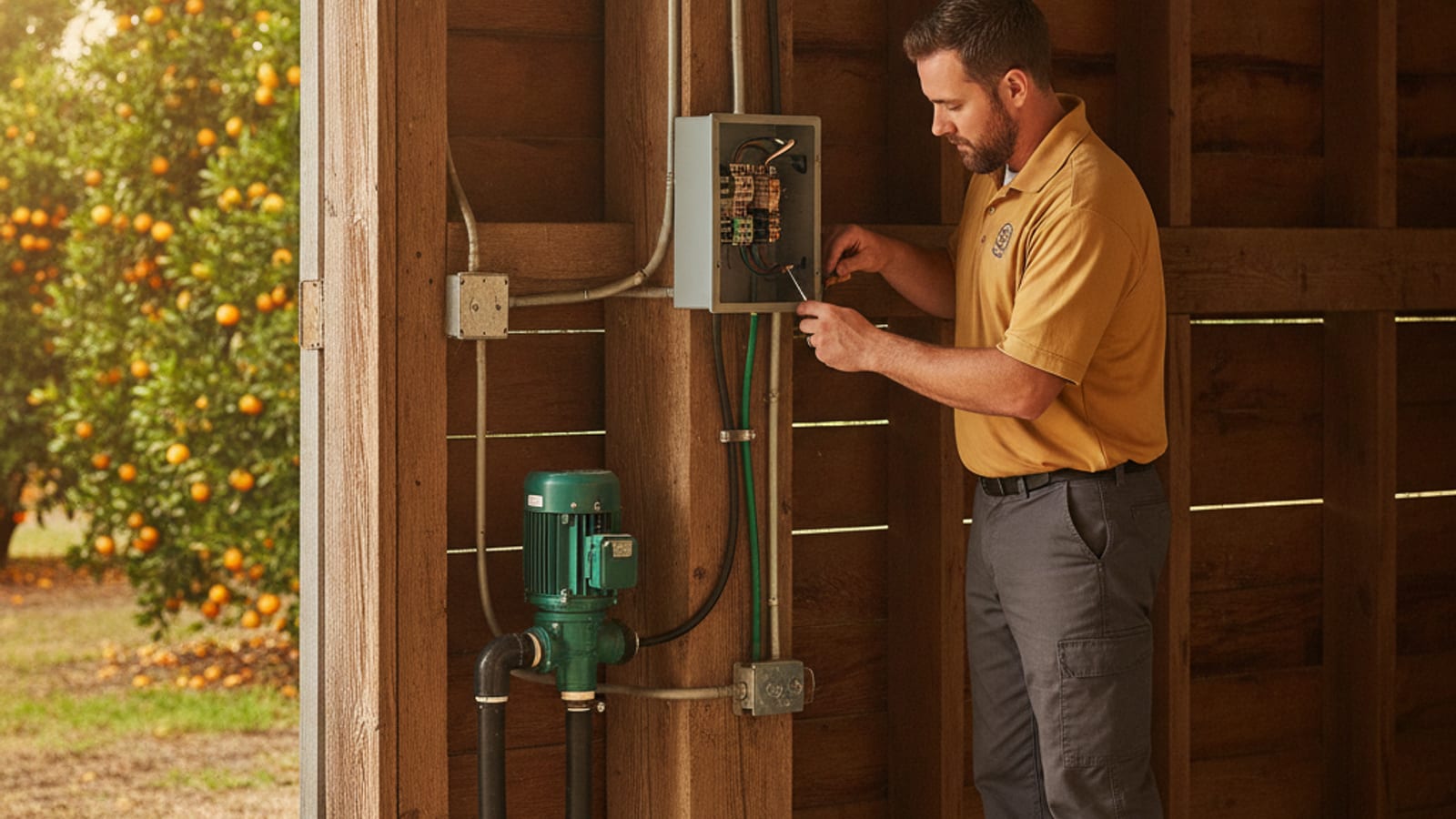
The Lake Wales Ridge, running through Lake Wales, Babson Park, and down toward Frostproof, still carries a working agricultural landscape, citrus groves, cattle operations, and small farms mixed in with newer residential growth. Electrical service for a barn, grove pump, or agricultural outbuilding out here is a genuinely different job than wiring a house, and it’s worth understanding why before you hire someone.
Barns and outbuildings need their own service, sized correctly
A barn or agricultural outbuilding usually needs its own electrical service, either fed from the main house panel through a sub-panel or, for larger operations, its own separate service entirely. Sizing this correctly depends entirely on what’s actually running in the building, well pumps, irrigation controls, lighting, refrigeration for produce or equipment, tools, and increasingly, EV or utility vehicle charging for farm equipment. A barn wired with a generic, undersized sub-panel is one of the more common issues we see on Lake Wales Ridge properties, usually because the original wiring was done for a much smaller operation than what the building eventually grew into.
A proper panel upgrade for agricultural use starts with an honest inventory of everything that runs, or might run in the next few years, off that circuit, not just what’s plugged in today.
Irrigation and grove pump wiring has its own failure patterns
Grove irrigation pumps, like residential well pumps, run on dedicated circuits and often include control boxes with capacitors and relays that manage motor start cycles. On agricultural property, these pumps are frequently running longer duty cycles than a residential well pump, and the wiring runs to grove pump locations can be considerably longer and more exposed than a typical house-to-well run, crossing open grove rows with more direct sun and weather exposure.
Pump failures on grove property often trace back to wiring degradation along these long exposed runs rather than the pump motor itself, similar to the pattern seen in rural residential well systems but usually on a larger scale given the distances involved. Regular inspection of these runs, rather than waiting for a failure during peak irrigation season, saves real money on a working grove operation where downtime has a direct cost.
Lightning exposure is higher on open agricultural land
Open grove and pasture land on the Lake Wales Ridge has less structure and tree cover than a residential neighborhood, which changes lightning exposure patterns for equipment and wiring runs out in the open. Polk County already sits in one of the highest lightning-frequency areas in the country, and agricultural equipment sitting at the end of a long exposed wiring run, irrigation pumps especially, takes on real strike-related risk during the summer storm season that runs heaviest June through September.
Surge protection sized for the specific equipment at risk, not just a standard residential setup, is worth discussing with an electrician who understands agricultural exposure specifically. A single grove pump control box replacement after storm damage often costs more than the surge protection that would have prevented it.
Grounding on agricultural property has its own considerations
Grounding requirements for barns and agricultural buildings, particularly ones housing livestock, follow specific code provisions distinct from standard residential grounding, partly because of animal safety considerations around stray voltage, a genuine issue in barns where improperly grounded equipment can create a small but detectable voltage that affects livestock behavior and welfare. This is a specialized area that not every residential electrician has direct experience with, and it’s worth asking directly about agricultural grounding experience before hiring for barn or livestock building work.
Generator backup for working operations
A working grove or cattle operation loses more than convenience during a power outage. Irrigation timing matters during dry stretches, refrigeration for produce or veterinary supplies can’t sit warm for long, and livestock watering systems that depend on an electric pump stop functioning the moment power drops. This is a different calculation than a residential generator decision, since the cost of a missed irrigation cycle or spoiled refrigerated inventory during hurricane season can outweigh the cost of a properly sized whole-home generator or dedicated agricultural standby unit within a single storm season.
Sizing backup power for agricultural use means accounting for the same startup-current considerations that apply to well pumps, but often multiplied across more equipment, irrigation pumps, refrigeration compressors, and any powered equipment used in daily operations. An electrician who’s sized backup power for working agricultural property specifically will ask about your actual operation, not just square footage, before recommending a generator size.
Outbuilding lighting for equipment sheds and processing areas
Beyond the main barn, most working Lake Wales Ridge properties have secondary structures, equipment sheds, packing or processing areas for citrus, and covered work areas, that need reliable lighting sized for actual work being done rather than a bare bulb hung from a rafter. Proper task lighting in a processing or equipment maintenance area isn’t just a convenience item, it affects safety when workers are handling equipment or produce during early morning or evening hours common in agricultural operations. This is worth including in the same electrical planning conversation as the main barn service, rather than treated as an afterthought once the primary building’s power is sorted out.
Well water for livestock and irrigation shares infrastructure with the house
On a lot of Lake Wales Ridge properties, the well serving the house also feeds livestock watering and irrigation systems, which means the electrical demands of household use and agricultural use are competing for the same source rather than running as separate systems. Understanding whether your property’s well and pump setup was ever sized for combined household and agricultural draw, or whether it was sized for the house alone with agricultural use added on later, matters when diagnosing pressure or capacity complaints that seem to appear only during heavy irrigation periods.
Permitting for agricultural electrical work
Permitting for agricultural buildings in unincorporated Polk County follows the county’s process, and requirements can differ from what applies inside city limits or for standard residential construction. Some agricultural exemptions exist for certain structures, but electrical service work generally still requires permitting regardless of the building’s agricultural classification. Confirm with your electrician what applies to your specific structure before assuming an agricultural exemption covers electrical work broadly.
Does a barn or agricultural building need its own electrical panel separate from the house?
For anything beyond minimal lighting, generally yes. A properly sized sub-panel or separate service accounts for pumps, refrigeration, tools, and other equipment specific to the building’s actual use, which a shared circuit off the house panel usually can’t support safely.
Why do grove irrigation pumps fail more often than residential well pumps?
The wiring runs are often longer and more exposed on agricultural property, crossing open grove rows with more direct sun and weather exposure, and duty cycles during irrigation season tend to be longer. Both factors accelerate wear on the wiring and control box components compared to a typical residential well setup.
Is stray voltage in a barn actually a real problem?
Yes, it’s a recognized issue in agricultural electrical work, particularly for livestock. Improperly grounded equipment can create small voltage differentials that affect animal behavior and welfare, which is why barn grounding follows specific code provisions beyond standard residential grounding.
Do I need a permit for electrical work on agricultural buildings in unincorporated Polk County?
Generally yes. Some structures may have certain agricultural exemptions, but electrical service work typically still requires a permit regardless of the building’s classification. Confirm with your electrician what applies to your specific structure before assuming otherwise.
How do I know if my barn’s existing wiring is adequate for what I’m running today?
The clearest sign of an undersized barn panel is nuisance tripping when multiple pieces of equipment run at once, a pump kicking on while lighting and tools are already drawing power, for example. If you’ve added equipment gradually over the years without ever revisiting the original electrical service, it’s worth having an electrician do a full load inventory rather than continuing to work around trips as they happen.
Can I add EV or utility vehicle charging to my existing barn service?
Often yes, but it depends on how much headroom the existing barn panel has beyond current equipment. Utility vehicle and equipment charging draws real, sustained current, so it’s worth including in the same load inventory conversation as any other planned addition rather than treating it as a minor add-on after the fact.
If you own barn, grove, or agricultural property anywhere along the Lake Wales Ridge and need electrical service sized correctly for how the property is actually used, call (863) 000-0000 and we’ll connect you with an experienced, insured local electrician who understands agricultural wiring.