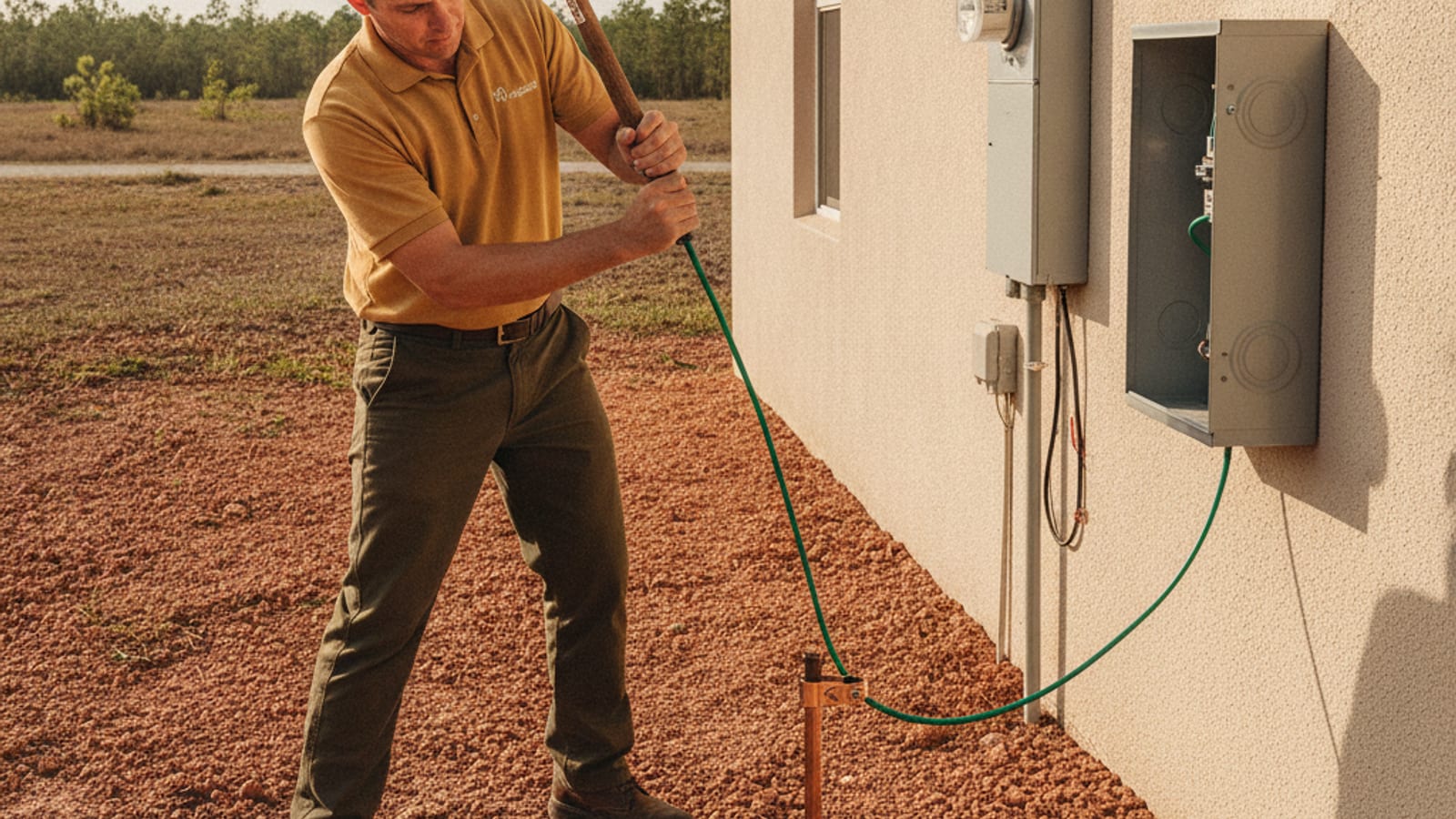
Mulberry, Bartow, and a good stretch of South Polk County sit inside the Bone Valley phosphate district, one of the most productive phosphate mining regions in the country for the better part of a century. A lot of residential and commercial development in this part of the county sits on reclaimed mine land, and the soil conditions that come with that history are worth understanding if you’re dealing with electrical grounding work here.
What reclaimed phosphate land actually means for soil composition
Phosphate mining in this district involves stripping and processing soil layers to extract phosphate rock, and reclaimed land is soil that’s been reshaped and, in many cases, engineered back into usable ground after mining concluded. The resulting soil composition can differ meaningfully from the area’s original, undisturbed soil, sometimes with different moisture retention, compaction, and mineral content than what an electrician would expect from typical Central Florida ground.
This matters for electrical grounding specifically because grounding rod effectiveness depends partly on soil resistivity, how readily the soil conducts electrical current to true earth ground. Reclaimed land with different composition than the surrounding natural soil can behave differently for grounding purposes than a standard residential lot elsewhere in the county.
Grounding rod effectiveness can vary more on reclaimed sites
Standard residential grounding typically uses one or two ground rods driven into the earth near the service entrance, sized and placed according to code requirements that assume relatively typical soil conditions. On reclaimed land with variable soil composition, a grounding system that would test fine on a standard Lakeland or Winter Haven lot can sometimes underperform if the specific soil at that location has different resistivity than assumed.
This isn’t a reason to assume every home in Mulberry or Bartow has a grounding problem, most don’t. It’s a reason to actually test grounding resistance on properties known to sit on reclaimed mine land, rather than assuming a standard installation automatically meets performance expectations without verification. A ground resistance test is a straightforward measurement an electrician can run as part of a broader electrical repair visit, and it gives you an actual number rather than an assumption.
Panel siting and service entrance considerations
Reclaimed land sometimes has different settling characteristics than undisturbed soil, particularly in the years and decades after reclamation as the engineered soil profile continues to stabilize. This can be relevant to where a service entrance or meter base is sited, since ground movement over time can affect underground conduit runs or the stability of ground-mounted equipment more than it would on more stable, undisturbed soil.
For new construction or a full panel upgrade on a property in this district, it’s reasonable to ask your electrician whether they’ve accounted for the site’s reclaimed-land history in how they’re siting and grounding the new equipment, rather than following a generic approach that doesn’t consider the local soil history.
This is a known issue in the district, not a fringe concern
Bone Valley’s mining and reclamation history is well documented and well known to civil engineers and builders who work in South Polk County regularly. It shows up in soil and geotechnical reports for construction projects across the district. Electrical grounding is a smaller piece of the same broader soil-conditions picture that affects foundation work, drainage, and other site considerations on reclaimed land, and it deserves the same level of attention.
What happens when a ground resistance test comes back marginal
If a test does come back showing higher than expected resistance, the fix usually isn’t dramatic. Options include adding a second or third ground rod, using a longer rod driven deeper where soil conditions allow, or in some cases installing a ground ring or grounding plate designed for challenging soil conditions. This is standard electrical practice used anywhere soil resistivity runs higher than typical, and it’s a solvable problem rather than a reason for concern once identified. The point of testing isn’t to find a crisis, it’s to catch a marginal condition while it’s a simple fix rather than after it’s caused a real electrical problem.
How this compares to sinkhole and karst concerns elsewhere in Polk County
Bone Valley’s reclaimed-land soil conditions are a distinct issue from the karst limestone and sinkhole activity found elsewhere in Polk County, though both ultimately come down to the same underlying question for a homeowner: is the ground under my service entrance behaving the way standard code assumptions expect it to. Karst-related ground movement involves limestone dissolution and cavity formation, while reclaimed mine land involves engineered soil that was reshaped after phosphate extraction. The mechanisms are different, but the practical takeaway for a homeowner is similar, verify rather than assume when your property sits on ground with a documented history of disturbance, whether that disturbance is geological or industrial in origin.
What this means for homeowners insurance conversations
Insurers evaluating a property in the Bone Valley district sometimes ask questions about soil conditions or foundation history that a homeowner might not immediately connect to electrical grounding. If your insurer is already asking about soil-related concerns for foundation or structural coverage, it’s a reasonable moment to also have your electrical grounding tested and documented, since you’re already having the soil conversation and a ground resistance test adds real documentation to the file at minimal additional cost or effort.
New construction on reclaimed land versus retrofitting an older home
New construction being built directly on reclaimed land today typically involves a geotechnical soil report as a standard part of the permitting and engineering process, which gives the electrician doing the original service installation real data about the specific site’s soil characteristics rather than a general assumption. Older homes built decades ago, sometimes before reclamation practices and geotechnical standards were as rigorous as they are today, don’t have that same documentation on file, which is exactly why a direct ground resistance test matters more for an existing older home than it does for a newly built one with an engineering report already in hand.
What to ask before electrical work on a reclaimed-land property
If you own property in Mulberry, Bartow, or elsewhere in the Bone Valley district and you’re having electrical work done, particularly new service installation or a panel upgrade, ask whether a ground resistance test is part of the scope. It’s a quick, inexpensive test relative to the cost of the overall work, and it gives you documented confirmation that your grounding system is performing the way code requires, rather than an assumption based on standard practice elsewhere in the county.
Does living on reclaimed phosphate land mean my home’s electrical grounding is automatically inadequate?
No. Most homes on reclaimed land in Mulberry and Bartow have perfectly adequate grounding. The point is that soil composition can vary more on reclaimed sites than on undisturbed land, which makes verification through an actual ground resistance test more valuable than assuming standard performance.
What is a ground resistance test and why does it matter here?
It’s a measurement of how effectively your grounding system conducts current to true earth ground, run using specialized test equipment. On reclaimed land with potentially variable soil composition, this test gives you an actual number rather than relying on an assumption based on typical soil conditions elsewhere.
Should I be concerned about ground movement affecting my electrical service on reclaimed land?
It’s worth discussing with your electrician if you’re doing new construction or a panel upgrade, since reclaimed soil can have different long-term settling characteristics than undisturbed ground. This is more relevant to new installation planning than to an existing, already-stable service that hasn’t shown problems.
Is this a widely known issue in the Bone Valley area or something unusual?
It’s well documented among engineers and builders who work in South Polk County regularly, and it shows up in geotechnical reports for construction projects across the reclaimed mining district. It’s a known regional soil consideration, not an unusual or fringe concern.
Does a ground resistance test cost extra on top of a panel upgrade or service call?
It’s a small add-on relative to the overall cost of a panel upgrade or new service installation, since the equipment and time involved are minimal compared to the rest of the job. Ask your electrician to include it as a line item on the quote so you know exactly what you’re paying for and can compare it against a quote that doesn’t include the test.
If you own property in the Bone Valley reclaimed-land district and want your electrical grounding actually tested rather than assumed, call (863) 000-0000 and we’ll connect you with an experienced, insured local electrician familiar with the area’s soil history.