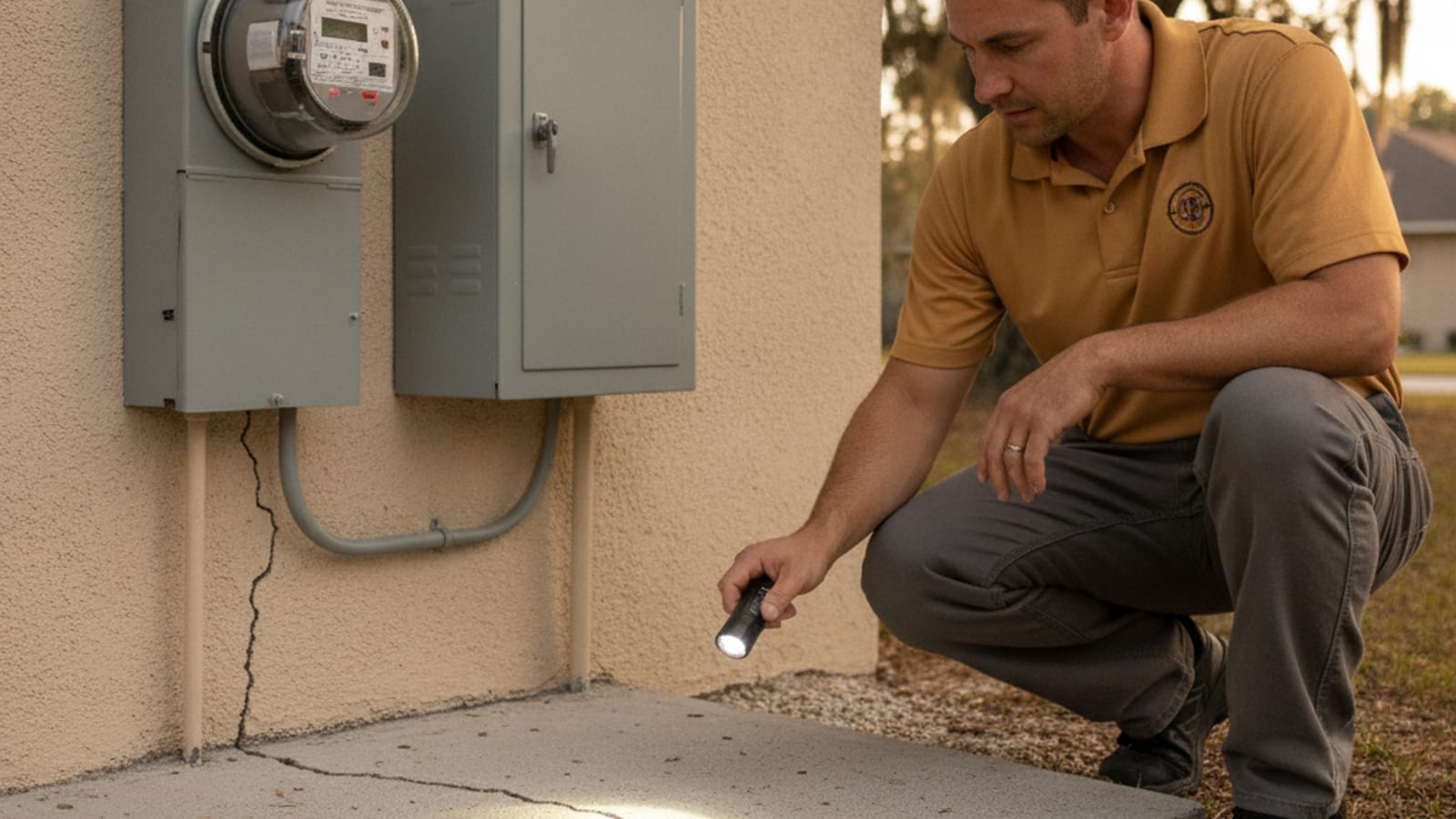
Polk County sits on karst terrain, limestone bedrock that dissolves gradually over time and creates the sinkhole activity Central Florida is known for. Most homeowners think about sinkhole risk in terms of foundations and insurance claims, but ground movement, even movement well short of a dramatic sinkhole collapse, can affect your home’s electrical service entrance and meter can in ways that are easy to miss until something actually fails.
Why service entrances are vulnerable to ground movement
A home’s service entrance, the point where utility power connects to your property, and the meter base it feeds, are typically mounted at grade level or on a concrete pad, with underground conduit running from there to the utility connection point in many newer installations. Gradual ground settlement, even minor settlement well short of what would trigger an insurance sinkhole claim, can shift or crack that mounting point over time, stress underground conduit runs, and in more serious cases affect the stability of the meter base itself.
This kind of gradual settlement is genuinely different from the dramatic, sudden sinkhole collapse that makes headlines. It’s slow, often not attributed to sinkhole activity by homeowners until an inspector or electrician points out signs, and it’s far more common across the county, from Bartow to Polk City, than the rare catastrophic events.
Early signs worth checking for
A meter base that’s visibly tilted or no longer sitting flush with its original mounting surface, cracking in the concrete pad around the meter or service entrance, or a service mast that appears to be leaning slightly compared to how it looked in older photos of the property are all worth having an electrician evaluate, particularly alongside any other signs of foundation settlement elsewhere on the property. None of these signs alone confirm sinkhole-related movement, plenty of settlement is unrelated to karst activity, but they’re worth a professional look rather than assuming everything’s fine because the lights still work.
If you’re noticing breaker issues, flickering, or connection problems that seem to coincide with any visible ground movement or cracking near the meter, that combination is worth taking seriously as a possible sign that underground conduit or the service entrance mounting has been affected. This kind of issue falls under general electrical repair but benefits from an electrician who’s specifically looking at the ground conditions around the equipment, not just the wiring itself.
What an electrician checks in this situation
A proper evaluation of a service entrance with suspected ground movement checks whether the meter base and mast are still securely and safely mounted, tests for any conduit damage that might have occurred from underground shifting, and confirms grounding is still functioning correctly, since ground rods and grounding conductors can be affected by the same soil movement that affects the visible structure above ground. This is a different scope than a routine electrical inspection, since it’s specifically looking for movement-related damage rather than general wear.
What this means if you already have a sinkhole claim in progress
If your property has an active or resolved sinkhole insurance claim, it’s worth having the electrical service entrance specifically checked as part of, or after, that process, separate from the structural remediation work insurers typically focus on. Structural sinkhole repair addresses the foundation and slab, but it doesn’t always include a specific check of the electrical service entrance and underground conduit, which can be affected by the same ground movement that triggered the claim in the first place.
Why this deserves attention even without a confirmed sinkhole
Most ground movement in Polk County never escalates into a dramatic collapse or a formal sinkhole claim. It simply settles gradually over years, which is exactly why it’s easy to dismiss as unimportant. But the electrical service entrance is one of the few points on a property where even modest ground movement has a direct safety consequence, since it’s the connection point for the full electrical load of the home. Treating a tilted meter base or a cracked pad as a cosmetic issue rather than a potential safety and function issue is the mistake worth avoiding here, regardless of whether the underlying cause ever gets formally attributed to karst activity.
Buried conduit runs are the harder issue to catch
A visibly cracked meter pad is at least something a homeowner can see during a normal walk around the property. Underground conduit connecting the meter base to the panel, or running from the panel to a detached garage, shed, or well pump, is a different story, since damage there stays hidden until a circuit starts failing intermittently or stops working entirely. Ground movement subtle enough to never crack a visible pad can still shift or crack buried conduit below grade, and the first sign a homeowner usually gets is a circuit that trips for no obvious reason or an outlet in a detached structure that stopped working.
If you have any underground electrical runs on your property, to a well pump, a detached garage, a dock, or a shed, and you’ve had any documented ground movement on the property for any reason, it’s worth having those runs specifically checked rather than only focusing on the visible meter base and service mast.
What a home inspector typically misses
A standard home inspection during a sale usually checks that the electrical panel is functioning and outlets test correctly, but it’s not generally scoped to evaluate ground stability around the service entrance or trace buried conduit for movement-related damage. This means a property can pass a standard home inspection while still having early-stage ground movement issues around the electrical service that simply weren’t part of what the inspector was contracted to check. If you’re buying a property anywhere in Polk County’s more active karst zones and want real confidence in the electrical service specifically, it’s worth requesting a dedicated electrical evaluation separate from the general home inspection, particularly if the seller’s disclosure mentions any history of ground movement or foundation work.
When to call an electrician versus a structural engineer
Ground movement affecting your home overall, cracking walls, uneven floors, doors that won’t close, is a structural engineering question first. But once you’re specifically asking whether the electrical service entrance itself is safe and functioning correctly, that’s an electrical question, and it’s reasonable to have both professionals involved if you’re dealing with confirmed or suspected sinkhole activity on your property. If the movement has damaged wiring beyond the service entrance itself, that broader electrical repair work should also get a look while the electrician is already on site, and a home already dealing with panel-related settlement issues is often a candidate for a panel upgrade evaluation at the same time.
How do I know if ground movement near my meter is sinkhole-related or just normal settling?
You generally can’t tell definitively without a professional evaluation. Both are possible in Polk County given the karst terrain, and an electrician can assess whether the movement has affected the service entrance’s safety and function regardless of the underlying cause.
Can ground movement near my meter actually cause an electrical hazard?
Yes, in some cases. Shifted or cracked mounting points, damaged underground conduit, or compromised grounding from soil movement can create real safety issues, which is why visible cracking or tilting near a meter base is worth having checked rather than ignored.
Does homeowners insurance cover electrical damage from sinkhole activity?
This depends on your specific policy and Florida’s sinkhole coverage requirements, which have their own rules separate from standard structural coverage. Check with your insurance provider directly about what your policy covers regarding sinkhole-related damage to electrical systems.
Should I get my electrical service entrance checked if I’ve had foundation settlement but no confirmed sinkhole?
It’s a reasonable precaution. Any ground movement significant enough to affect your foundation is worth having your electrician check the service entrance and underground conduit for related effects, even without a confirmed sinkhole diagnosis.
Will a standard home inspection catch ground-movement damage to my electrical service?
Not reliably. A standard inspection checks that the panel and outlets function correctly, but it isn’t generally scoped to evaluate ground stability or trace buried conduit for movement-related damage, which is why a dedicated electrical evaluation is worth requesting separately if you have any reason to suspect ground movement on the property.
If you’re seeing cracking, tilting, or other signs of ground movement near your meter base or service entrance anywhere in Polk County, call (863) 000-0000 and we’ll connect you with an experienced, insured local electrician who can evaluate it properly.