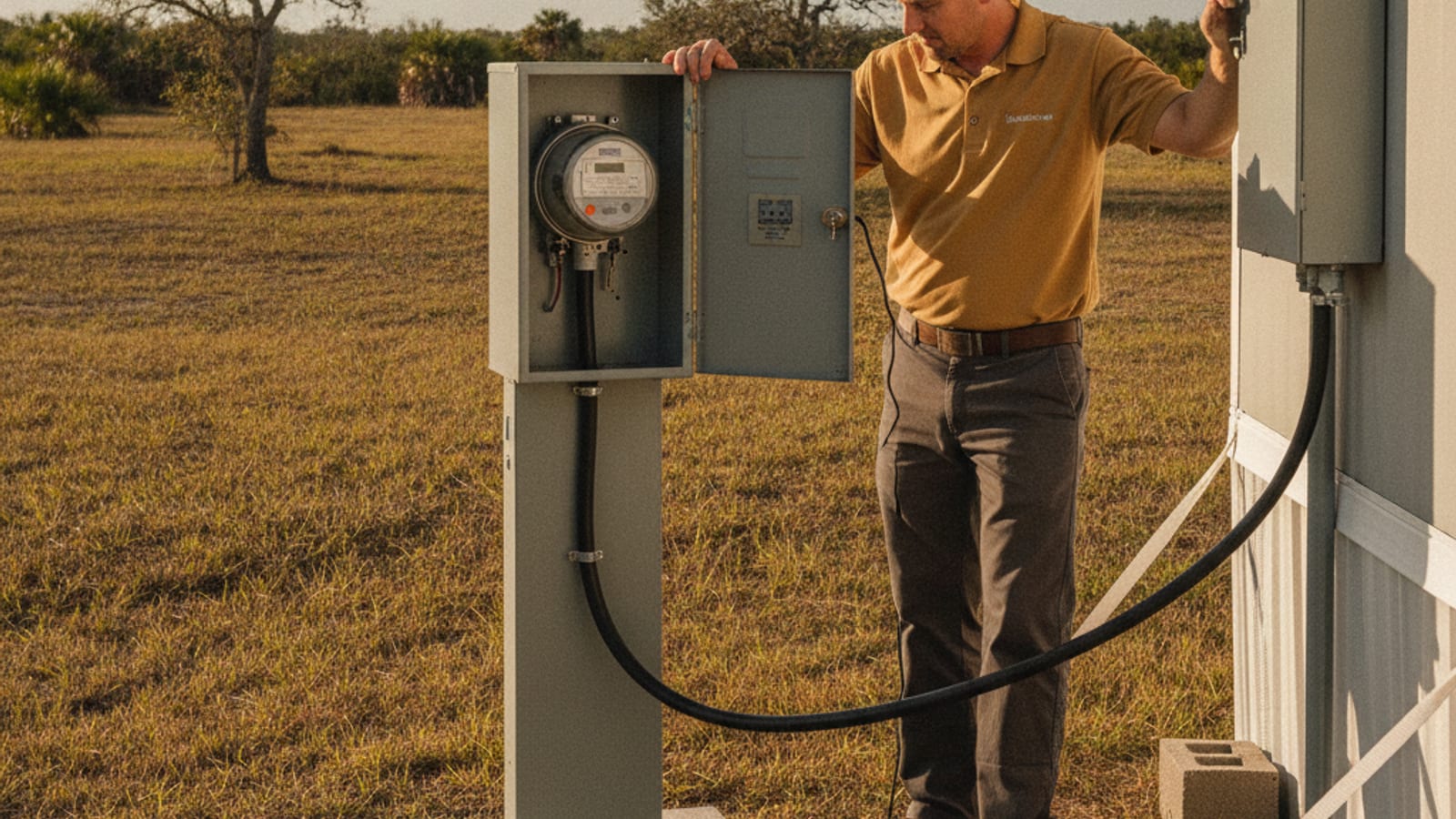
Polk County has one of the larger concentrations of mobile and manufactured homes in Central Florida, especially in the exurbs around Auburndale, Haines City, Lake Wales, Frostproof, and Fort Meade. If you own one, or you’re looking at buying one, the electrical system underneath it doesn’t work quite the same way a site-built house does, and a lot of general electrical advice online simply doesn’t apply.
The service pedestal is not the same as a house panel
A site-built home has a single service entrance and panel mounted on or in the structure itself. A mobile or manufactured home typically runs on a service pedestal, sometimes called a power pole or meter pedestal, set in the ground near the home with the meter, main disconnect, and often a small breaker panel all mounted on it. Power runs from that pedestal to a smaller panel inside the home through a feeder cable, usually underground.
That split matters because a problem can originate at the pedestal, in the underground feeder, or inside the home’s interior panel, and each of those requires a different diagnostic approach. A homeowner troubleshooting a tripped breaker inside the home might not realize the actual fault is at the pedestal outside, especially in an older mobile home where the underground feeder has been in the ground for decades without being checked.
Older feeder cables are a common failure point
Manufactured homes placed in Polk County in the 1970s through 1990s often still run on their original underground feeder cable, and that cable has a service life. Florida’s clay-heavy and sandy soil combination, plus decades of ground moisture cycling through wet and dry seasons, degrades buried cable insulation over time. A feeder that’s failing usually shows up as flickering lights that get worse when a major appliance kicks on, a breaker that trips intermittently with no clear pattern, or in more advanced cases a burning smell near the pedestal or the home’s tie-in point.
Replacing an underground feeder is more involved than swapping a breaker, since it usually means trenching a new run rather than pulling the old cable back through the existing conduit, which is often too degraded to reuse safely. It’s worth having a feeder inspected as part of any broader electrical repair visit if your manufactured home is older than about 25 years and you haven’t had that cable checked.
Panel capacity in older manufactured homes
A lot of older manufactured homes in Polk County, particularly ones placed before the early 1990s, came standard with 100-amp or even smaller service, sized for an era before central AC was universal and before households ran the number of electronics, chargers, and appliances that are now typical. Adding central air, a hot tub, or an EV charger to a home still running on original 60 or 100-amp service is a common source of nuisance tripping.
A panel upgrade on a manufactured home follows a similar process to a site-built house, sizing a new panel to actual household load, but the physical layout is different enough that it’s worth confirming your electrician has manufactured-home experience specifically. The panel location, the tie-in point to the pedestal, and the anchoring requirements inside a manufactured home’s wall cavity aren’t identical to stick-built construction.
Insurance and lender requirements can be stricter
Insuring a manufactured or mobile home in Florida already comes with its own underwriting scrutiny, and electrical system age is frequently part of that review. Some insurers specifically ask about the age of the panel and the condition of the service pedestal on manufactured homes, separate from the general panel-brand questions that apply to site-built houses. If you’re refinancing, selling, or renewing a policy on a manufactured home in Auburndale, Winter Haven, or the Haines City exurbs and get a letter flagging the electrical system, it’s the same kind of red flag a site-built homeowner would get with an aging or recalled panel brand, just applied to a different housing type.
Permitting differs by jurisdiction and home placement
Electrical permitting on a manufactured home in Polk County depends on both the specific improvement and where the home is titled, real property versus personal property, which affects which county or state process applies. This is genuinely more complicated than permitting for a site-built house, and it’s one of the areas where hiring someone unfamiliar with manufactured-home work in this county can cost you real time. Ask directly whether the electrician quoting your job has pulled manufactured-home permits in Polk County before, not just general residential permits.
Storm-related electrical damage shows up differently on manufactured homes
Manufactured homes sit closer to grade than a site-built house on a raised foundation, and the service pedestal itself is fully exposed outside with no structure around it for protection. During heavy summer storms, that pedestal and the underground feeder running from it are more exposed to wind-driven water intrusion at the meter can and connection points than a house’s service entrance typically is. After a significant storm, it’s worth having the pedestal and connection points checked for water intrusion even if nothing looks obviously damaged, since corrosion inside a meter can from storm water doesn’t always show visible signs right away.
Tie-down straps and anchoring systems required for manufactured homes can also affect where a service pedestal sits relative to the home after a storm, if any ground shifting or home settling occurred. This isn’t common, but it’s worth mentioning to your electrician if you’ve had any recent tie-down or anchoring work done, since it can occasionally affect the alignment of the feeder run between the pedestal and the home.
Additions and add-on rooms complicate the wiring picture
A lot of manufactured homes in the Polk County exurbs have had a Florida room, carport conversion, or add-on addition built over the years, sometimes by the original owner, sometimes by a previous one. These additions were not always wired by a licensed electrician, and it’s common to find an add-on room fed by an extension cord run through a wall, a tapped circuit that was never sized for the additional load, or wiring that doesn’t meet the same code standard as the rest of the home. This is one of the more common findings during a manufactured home electrical inspection in this part of the county, and it’s worth specifically asking about if you’re buying a home with any visible additions.
Bringing an add-on room up to a proper dedicated circuit, rather than leaving it on a shared or improvised feed, is usually a modest electrical repair job compared to the cost of a full panel upgrade, but it’s the kind of item that only gets caught by someone specifically looking for it rather than a general walk-through.
What to check before buying a manufactured home in this area
If you’re shopping for a manufactured home anywhere in the Wahneta, Combee Settlement, or rural exurb areas, ask for the age of the service pedestal and panel specifically, separate from any general home inspection. A standard home inspection sometimes treats the electrical system as a single line item without distinguishing pedestal age from interior panel age, and those two components can be very different vintages if the home has been moved or had partial electrical work done at some point in its history.
Do manufactured homes in Polk County need a different kind of panel than site-built houses?
Not a fundamentally different type, but the layout is different. Power comes in through a service pedestal outside the home rather than a single service entrance, and the interior panel and its tie-in point have different mounting requirements than a stick-built house.
How often should the underground feeder cable be inspected?
There’s no fixed schedule, but a feeder older than 25 years that hasn’t been checked is worth having inspected, especially if you’re seeing flickering lights or intermittent breaker trips. Soil moisture cycling in Polk County degrades buried cable insulation over time.
Can I upgrade my mobile home’s electrical panel to add central air or an EV charger?
Usually yes, but it depends on the pedestal’s total capacity as well as the interior panel. An electrician needs to check both before quoting an upgrade, since undersizing either piece leaves you back where you started.
Is electrical work on a manufactured home permitted differently than a site-built house?
Often, yes. Permitting can depend on whether the home is titled as real property or personal property, which affects which process applies. Confirm your electrician has specific manufactured-home permitting experience in Polk County before starting work.
If you own or are buying a manufactured home anywhere in Polk County and want the electrical system, pedestal included, checked by someone who actually works on this housing type regularly, call (863) 000-0000 and we’ll connect you with an experienced, insured local electrician.