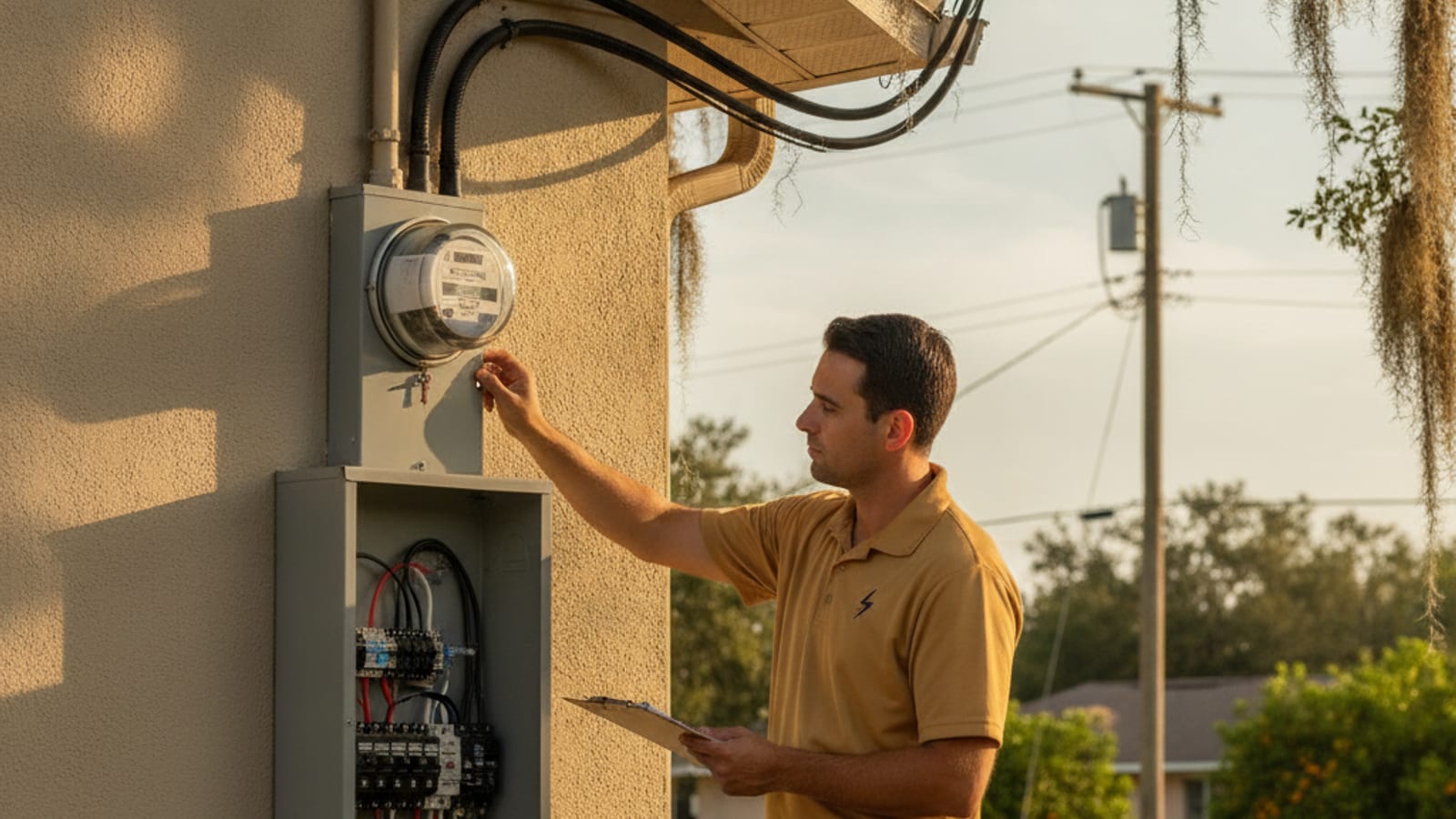
Most homeowners find out Polk County has three different electric utilities the hard way, usually mid-permit, when a contractor mentions a utility disconnect step that sounds unfamiliar. If you’re planning a panel upgrade, knowing which utility actually serves your address before you start saves a week of back-and-forth.
Why Polk County has three electric utilities in one county
Lakeland is one of a small number of Florida cities that still runs its own municipal electric utility, Lakeland Electric, rather than buying power from a private investor-owned company. That footprint covers most of the city proper, but it doesn’t extend county-wide. Step outside the city limits in almost any direction and you land in either Duke Energy Florida territory or a corner served by TECO, Tampa Electric’s Polk County edge. Three separate utilities, three separate disconnect and reconnect processes, three separate sets of paperwork a permit-pulling electrician has to know cold.
This isn’t unique to electrical work. Water, sewer, and even some public safety response lines split the same way across city and county boundaries here. But for electrical permitting specifically, the utility question comes up on nearly every panel upgrade, because upgrading from a 100-amp to a 200-amp service almost always requires a temporary utility disconnect while the new panel goes in.
What changes if you’re inside Lakeland city limits
Inside Lakeland Electric’s territory, the utility coordinates directly with the city’s building and permitting department, and the process tends to move on a fairly predictable schedule once a permit is pulled. Lakeland Electric handles its own metering and disconnect scheduling, which means the coordination is a single phone call rather than a handoff between a private utility and a separate county permitting office. Homes in Dixieland, Lake Morton, and the older core of the city typically fall inside this footprint.
The tradeoff is that Lakeland Electric’s own inspection and reconnection windows don’t always match the county’s general contractor scheduling assumptions, so an electrician who mostly works Duke or TECO territory can genuinely be caught off guard the first time they pull a permit in Dixieland or another inside-city neighborhood. It’s worth asking directly whether the electrician quoting your electrical repair or panel job has pulled Lakeland Electric permits before, not just Polk County ones generally.
Duke Energy Florida territory: what to expect outside city limits
Once you’re outside Lakeland’s municipal boundary, most of the surrounding unincorporated county and a large share of Winter Haven, Auburndale, and the North Polk lake communities fall under Duke Energy Florida. Duke’s disconnect and reconnect process runs through its own scheduling system, and because Duke serves a huge multi-county footprint across Central Florida, the process is more standardized but sometimes slower to book during peak construction season, which in Polk County tends to run spring through early summer.
A panel upgrade in Duke territory usually adds a day or two of lead time compared to an inside-city-limits Lakeland Electric job, mostly because the disconnect request goes into a regional queue rather than a local one. That’s not a reason to avoid the work, just something to plan around if you’re targeting a specific completion date, like before an EV charger install or before a home sale closes.
Where TECO’s edge reaches into Polk County
Tampa Electric’s service territory mostly sits in Hillsborough County, but a slice of western Polk County near the county line falls under TECO rather than Duke or Lakeland Electric. This edge territory is smaller and less commonly discussed, which means some homeowners in that pocket don’t realize they’re dealing with a third utility until a permit application gets flagged for the wrong utility contact.
If your property sits anywhere near the Hillsborough-Polk line, it’s worth confirming your utility provider directly rather than assuming based on your mailing address or nearby neighbors, since utility territory boundaries don’t always follow city or county lines cleanly.
Annexation can change your utility years after you bought the house
Lakeland has annexed land into the city limits periodically over the decades, and when a property moves from unincorporated Polk County into the city, its utility provider can change from Duke Energy Florida to Lakeland Electric as part of that process. This catches longtime homeowners off guard more often than you’d expect, someone who bought a house in Duke territory fifteen years ago and never checked again assumes nothing’s changed, then finds out mid-permit that their address annexed into the city at some point and now falls under Lakeland Electric.
This is exactly the kind of detail worth confirming before a panel upgrade rather than assuming your utility provider is whatever it was when you moved in. A quick look at a recent bill settles it, but relying on memory or an old closing document from years ago is a common way homeowners end up surprised by a permit hiccup.
Coordinating your utility disconnect with other trades
A panel upgrade rarely happens in isolation. Homeowners often bundle it with other work, a new AC install, a roof replacement that requires a temporary electrical disconnect, or an EV charger install that depends on the panel upgrade finishing first. When multiple trades are touching the same property around the same utility disconnect window, the utility question becomes even more important, because a scheduling conflict between, say, a roofer’s timeline and Duke’s disconnect queue can push a whole project back by more than a week if nobody coordinated it in advance.
If you’re planning a multi-trade project that touches your electrical service, it’s worth telling every contractor involved which utility serves your address up front, and asking your electrician to confirm the disconnect window before the other trades lock in their own schedules. A panel upgrade that’s ready to go but stuck waiting on a Duke disconnect slot can hold up an AC install or a roofing crew that’s only available for a specific window, which turns a minor scheduling detail into a real cost if crews have to reschedule.
How this plays out differently for new construction versus existing homes
New construction anywhere in Polk County goes through utility coordination as part of the original build process, so the utility question is usually already settled by the time a homeowner moves in. Where this section matters most is for existing homes changing hands, being renovated, or being upgraded years after original construction, since utility territory isn’t something most people think to double check unless a permit application forces the issue. If you’re buying a resale home anywhere near a city boundary or a former annexation area, confirming the utility provider as part of your due diligence, alongside the usual home inspection items, avoids a surprise later when you’re ready to upgrade the panel.
How to find out which utility serves your address before you call anyone
The fastest way to confirm your utility is your own electric bill, which will show either Lakeland Electric, Duke Energy Florida, or TECO as the biller. If you’re buying a home and don’t have a bill yet, each utility’s website has an address lookup tool, and a quick call to any of the three will typically redirect you to the right one if you’ve guessed wrong. Confirming this before you request quotes means every electrician bidding your panel upgrade is working from the same permit assumptions, rather than one contractor quoting a Lakeland Electric timeline and another quoting a Duke timeline for the same job.
What this means for your panel upgrade timeline
None of this changes what a panel upgrade actually costs or how long the physical work takes, a licensed electrician still needs roughly a day on site regardless of utility. What changes is the coordination window around the outage itself, the piece of the process a homeowner doesn’t see but definitely feels if it runs long. An electrician who asks about your utility provider before quoting a firm start date is doing the coordination work up front instead of discovering the issue mid-project.
Does my utility territory change how much a panel upgrade costs?
Not directly. The labor, materials, and permit fees are largely the same regardless of which of the three utilities serves your address. What can shift is the scheduling window around the required disconnect, since each utility runs its own queue.
How do I know if I’m in Lakeland Electric, Duke, or TECO territory?
Check a recent electric bill, it will list the utility by name. If you don’t have one yet, each utility’s website has an address-based lookup, or you can call directly and ask.
Can I choose which utility serves my home?
No. Utility territory is assigned geographically and isn’t a choice a homeowner or electrician can make. The address determines the provider.
Should I mention my utility provider when getting quotes for electrical work?
Yes. Telling every electrician you’re getting quotes from which utility serves your address lets them give you an accurate timeline instead of a generic estimate that might not account for that utility’s specific disconnect and inspection process.
If you’re not sure which of the three utilities covers your address or you’re ready to talk through a panel upgrade timeline, call (863) 000-0000 and we’ll connect you with an experienced, insured local electrician who works in your specific territory.