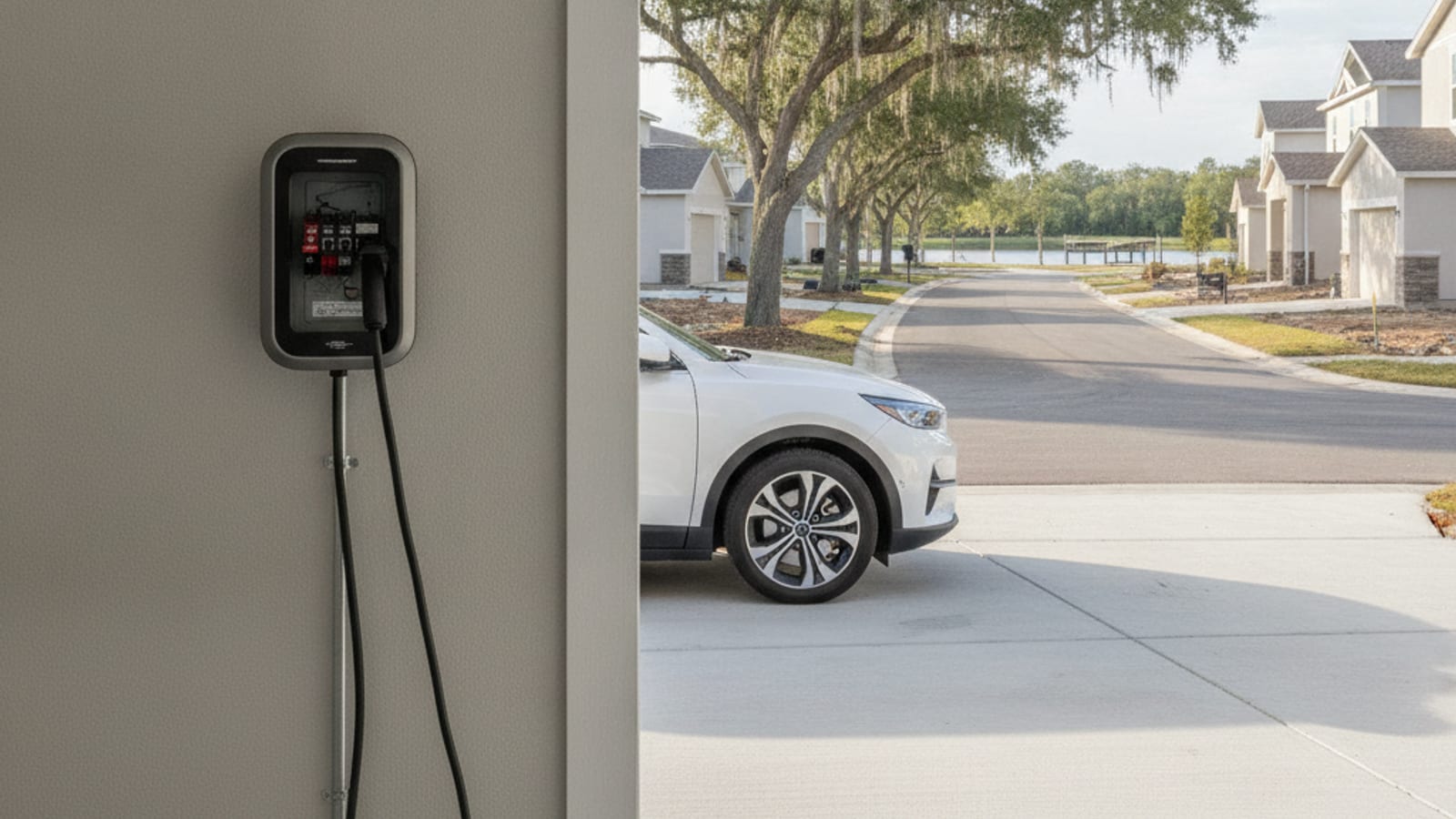
Davenport, Four Corners, and the newer developments spreading along the I-4 and US-27 corridor are some of the fastest-growing pockets in Polk County, full of new-construction homes, vacation properties, and a homeowner base that skews younger and more likely to already own or be shopping for an EV. That combination creates a different set of EV charger install questions than you’d get from an older home in Lakeland’s historic core.
New construction panels are usually sized better, but not always for a charger
The good news for I-4 corridor new construction is that most homes here were built with 200-amp service as standard, which is generally enough headroom to add a Level 2 EV charger without needing a full panel upgrade first. The catch is that builder-standard panels are sized for the home’s baseline load, central AC, appliances, water heater, not necessarily with an EV charger’s roughly 40 to 60-amp draw already factored in.
A proper load calculation before installation tells you whether your specific panel has room for a dedicated EV circuit alongside everything else already running, or whether you need a panel upgrade or a smart charger with load management to avoid overloading the service. Builder documentation doesn’t always include this calculation, so it’s worth having an electrician run it rather than assuming new construction automatically has capacity to spare.
Short-term rental and vacation home considerations
A meaningful share of new construction in Davenport and Four Corners is built or purchased specifically as short-term rental property tied to the Orlando theme park market. If your property operates as an STR, an EV charger is increasingly something guests expect or ask about, but it also raises questions a primary-residence install doesn’t: charger access for guests who aren’t the homeowner, liability considerations around guest use, and whether the charger needs to be on a separate metered circuit for cost tracking purposes.
None of these are reasons to avoid installing a charger at a rental property, but they’re worth thinking through before installation rather than after, since retrofitting access controls or separate metering later is more expensive than planning for it during the original install.
Smart-home buyer expectations are higher on this corridor
Homebuyers in the newer I-4 corridor developments tend to have higher expectations around smart-home integration generally, and EV charging is often part of that picture. A charger that integrates with home automation, schedules charging around off-peak utility rates, or reports usage data to an app is increasingly what buyers in this market ask for, compared to a simple charger with no connectivity. This matters for resale value in a market where the buyer pool skews toward exactly this kind of buyer.
Choosing between a dedicated circuit and a shared load management setup
For a single-EV household with adequate panel capacity, a straightforward dedicated 240-volt circuit is usually the simplest and most reliable setup. For households planning to add a second EV, or new construction where the panel is already close to capacity with other electric loads, a smart charger with load management can share available capacity intelligently rather than requiring a full panel upgrade. Which approach makes more sense depends on your specific panel’s headroom, which is why the load calculation step matters before choosing equipment.
Garage layout and wire run distance matter more in newer floor plans
A lot of I-4 corridor new construction favors larger three and four-car garages set back from the main panel location, sometimes on the opposite side of the house entirely. Wire run distance from the panel to the charger location directly affects both cost and, at longer distances, whether wire gauge needs to increase to avoid voltage drop. A garage set far from the panel in a sprawling new-construction floor plan can turn what looks like a simple install on paper into a more involved conduit run, especially if the run needs to cross a finished garage ceiling or go through an attic space.
It’s worth having your electrician walk the actual planned charger location relative to the panel before finalizing a quote, rather than assuming a standard distance based on a typical smaller home. New construction floor plans in this market vary widely enough that a generic price estimate based on square footage alone isn’t reliable.
HOA considerations in newer developments
Most new-construction communities along the I-4 corridor have an active HOA, and some HOAs have specific rules or approval processes for exterior modifications, which can include garage-mounted EV chargers depending on how visible the installation is from the street. This is rarely a reason to avoid installing a charger, most HOAs have adapted to EV charging as a routine request rather than something unusual, but it’s worth checking your community’s specific architectural review process before scheduling installation, particularly if any part of the conduit run or equipment will be visible on an exterior wall.
Planning for a second vehicle down the road
Even if you only own one EV today, it’s worth telling your electrician if you’re likely to add a second EV to the household within the next few years, since that changes whether a simple dedicated circuit or a load-managed setup makes more sense from the start. Retrofitting a second charger circuit later is more expensive than accounting for it during the original install, particularly if the first install used up most of the panel’s available headroom without leaving room for a second circuit.
New construction warranty and electrical work don’t always mix cleanly
Homes still under a builder’s structural or systems warranty raise a specific question when adding an EV charger: does the added circuit or any panel work affect warranty coverage on the electrical system. Most builder warranties don’t void coverage over a properly permitted addition like an EV charger circuit, but it’s worth confirming with your builder or reading your warranty documentation before assuming, particularly if anything about the install touches the original panel rather than simply adding a new breaker to open capacity. Keeping documentation of any electrical work done during the warranty period, permits included, protects you if a warranty question comes up later during an unrelated claim.
What installation typically costs on this corridor
A straightforward Level 2 EV charger installation with adequate existing panel capacity typically runs in a moderate range depending on charger brand, wire run distance from the panel to the garage, and whether any additional permitting applies for new construction that’s still under warranty. If a panel upgrade is needed first, that adds a separate cost on top of the charger install itself. Any electrician quoting your job should give you a fixed number after seeing your specific panel and garage layout, not a phone estimate based on charger brand alone.
Federal incentives have changed
If you’re factoring a federal tax credit into your EV charger budget, confirm current eligibility before you commit to a purchase date. Federal incentives for home electrical equipment installs have changed substantially and some expired for installs completed after the end of 2025, so a number you saw quoted a year ago may no longer apply. Your electrician can tell you what’s currently available at quote time, but don’t assume last year’s incentive still holds.
Do new construction homes in Davenport already have EV charger capacity built in?
Not automatically. Most have adequate 200-amp panels, but the specific headroom for an EV charger’s load depends on what else is already running on the panel. A load calculation confirms this before installation rather than assuming capacity based on panel size alone.
Is installing an EV charger at a short-term rental different from a primary residence?
The physical installation is similar, but STR properties often need additional planning around guest access, liability, and sometimes separate metering for usage tracking, none of which applies to a primary residence install.
What size circuit does a typical Level 2 EV charger need?
Most Level 2 chargers need a dedicated 240-volt circuit in the 40 to 60-amp range, though this varies by charger model and vehicle. Your electrician sizes the circuit specifically for the charger and vehicle you’re installing for.
Are federal tax credits still available for EV charger installation?
Some federal incentives for home electrical work have expired or changed significantly for installs after the end of 2025. Confirm current eligibility and amounts directly with your electrician or a tax professional at the time you’re quoting the project, not based on older information.
If you’re planning an EV charger install anywhere along the I-4 or US-27 corridor, whether it’s a primary residence or a vacation rental, call (863) 000-0000 and we’ll connect you with an experienced, insured local electrician who can run the load calculation and give you a real number.